
BANDUNG, Indonesia — A wave of student protests continued in the city of Bandung this week, with demonstrations taking place three times between June 12-17, 2026, outside the West Java Regional House of Representatives (DPRD) building. The protesters called on the government to address an economic crisis they say is burdening people's lives and opposed what they described as the growing involvement of the military in civilian affairs.
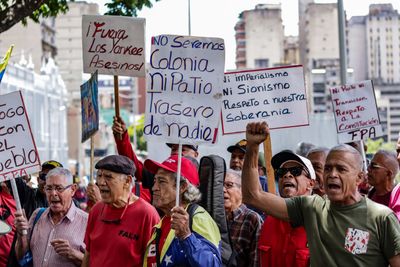
On Wednesday afternoon, more than a thousand students gathered along Diponegoro Street in front of the provincial legislature building. Most of them wore their university jackets and arrived together on foot. The crowd carried organizational flags, banners and posters criticizing government policies. Some displayed slogans reading, "Mas Bowo Failed," "Your Promises Were Empty Talk," "Repeal the TNI-Police Law," and "Rise Up and Reclaim Sovereignty."
Before reaching the protest site, however, participants were required to undergo security checks conducted by police officers. Journalists at the scene observed officers inspecting students' belongings before allowing them to enter the demonstration area.
The students then assembled in front of the West Java DPRD building, forming a large circle. Police officers stood guard on both the eastern and western sides of the venue, equipped with tactical gear including batons, shields and crowd-control vehicles. The front gate of the legislature building was also heavily guarded.
During the protest, demonstrators brought a brown-colored replica guillotine, a device historically associated with the French Revolution and used to execute officials accused of corruption. The prop was placed at the center of the gathering.
Shortly afterward, a protest speaker addressed the crowd through a loudspeaker, criticizing what he described as the country's current condition and policies that have made life increasingly difficult for ordinary people.
Two men wearing masks depicting Indonesian President Prabowo Subianto and Vice President Gibran Rakabuming Raka were then directed onto the platform beneath the guillotine. The participant wearing the Prabowo mask stepped forward first and placed his head beneath a replica blade bearing the words "RIP Democracy."
The blade was slowly lowered, prompting cheers from the crowd. A participant wearing a Gibran mask was then symbolically "executed" beneath the guillotine as demonstrators applauded and shouted, "Revolution."
Muhammad Risaldi, coordinator of the West Java chapter of the All-Indonesia Student Executive Bodies Alliance (BEM SI), said the beheading performance was an expression of frustration among students.
"We are fed up and ready to behead what Prabowo and Gibran have created during this period in office," he said on the sidelines of the demonstration. "We believe the current government operates arbitrarily and continues to issue regulations and policies that are not participatory and do not involve meaningful public participation."
He also highlighted what he described as the large number of political prisoners under the Prabowo-Gibran administration, which he claimed had reached around 900 people based on data available to him. According to Risaldi, the current number exceeds that recorded under previous administrations.
The demands raised by students remained largely unchanged from earlier protests, focusing on rising fuel prices, the weakening rupiah exchange rate and the increasing cost of living. In addition to economic issues, demonstrators called for education reform and urged the government to strengthen the principle of civilian supremacy.
One of the themes most frequently raised in speeches was concern about the increasing involvement of military personnel in civilian positions and affairs. During the New Order era, the military played a major role in government through the "dual function" doctrine, which allowed military officers to occupy political and bureaucratic posts.
Following Indonesia's democratic reforms in 1998, a series of changes were implemented to limit military involvement in politics and strengthen civilian control over state institutions. For many years, those reforms were regarded as one of the country's key democratic achievements.
In recent years, however, several civil society groups have voiced concerns that military influence is expanding again through the appointment of active and retired military personnel to various government institutions. The government has repeatedly stated that such involvement complies with existing regulations and has rejected accusations of democratic backsliding.
Beyond concerns about democracy, deteriorating economic conditions have also become a major driver of the student movement. Demonstrators argued that a roughly 30% increase in the price of non-subsidized fuel could raise transportation costs and push up the price of basic necessities. At the same time, the weakening rupiah has heightened concerns about purchasing power.
Nahdah Nabillah, chairperson of the Student Family Association at the Bandung Institute of Technology (ITB) and one of the protesters, said the rising cost of living was among the issues most acutely felt by younger generations. Many young Indonesians, she said, are becoming increasingly anxious about their future.
She added that students' demands extend beyond the price of basic goods and living expenses, encompassing broader economic governance reforms. According to her, the government needs to take measurable steps to strengthen purchasing power amid ongoing economic pressures.
Students also called for improvements in governance and stronger oversight mechanisms. Nabillah argued that government programs should be implemented transparently and involve public participation in decision-making processes. The Free Nutritious Meals (MBG) program and the Red-and-White Cooperative initiative were among the policies most frequently criticized by protesters.
She further said the government should develop a long-term strategy to strengthen the national economy by expanding research- and innovation-based industries. Such efforts, she argued, are necessary to reduce Indonesia's dependence on sectors vulnerable to global economic fluctuations.
In addition, she said communication from the government needed improvement. Recent public debates over state policies, she said, have demonstrated the need for information that is clear, data-driven and easily understood by the public.
"At a time like this, society needs information that is based on facts and real data so that polarization does not continue to deepen. We need a united public voice and a sharper understanding of the issues and challenges we face," she said.
The students also called for a comprehensive evaluation of the Red-and-White Village Cooperative (KDMP) program and the Free Nutritious Meals (MBG) initiative. They demanded that the government protect the state budget from wasteful spending, improve presidential communications, repeal the TNI Law and Police Law, and uphold human rights while combating impunity.
As evening approached, the more than 1,000 students gradually dispersed. Wednesday's protest remained largely peaceful, although a demonstration on Monday, June 15, turned briefly chaotic as protesters began leaving the DPRD complex.
West Java Police Chief Inspector General Rudi Setiawan said authorities had implemented strict security measures to prevent provocateurs from infiltrating the demonstrations.
"We are providing protection for the students so they can demonstrate safely and without interference from provocateurs. We are also ensuring that they feel secure because we are protecting everyone involved," he said.
He expressed hope that future demonstrations organized by students and other members of society would remain peaceful and orderly. According to him, a stable environment is one of the prerequisites for achieving prosperity.
"Because we can only progress and prosper if stability is maintained. That is my message to all students and other members of society who wish to exercise their democratic rights," he said.
"Hopefully we can continue to preserve this mechanism for expressing opinions," he added.
Photo by Gilang / JNA Press